Diagnose Any Vehicle Fault — Petrol, Diesel, Hybrid, or EV
A fully accredited, US & UK certified 6-month practical course that trains technicians to confidently diagnose faults across Petrol, Diesel, EV, and Hybrid vehicles — covering 21 deep-dive modules and 100+ supporting videos.
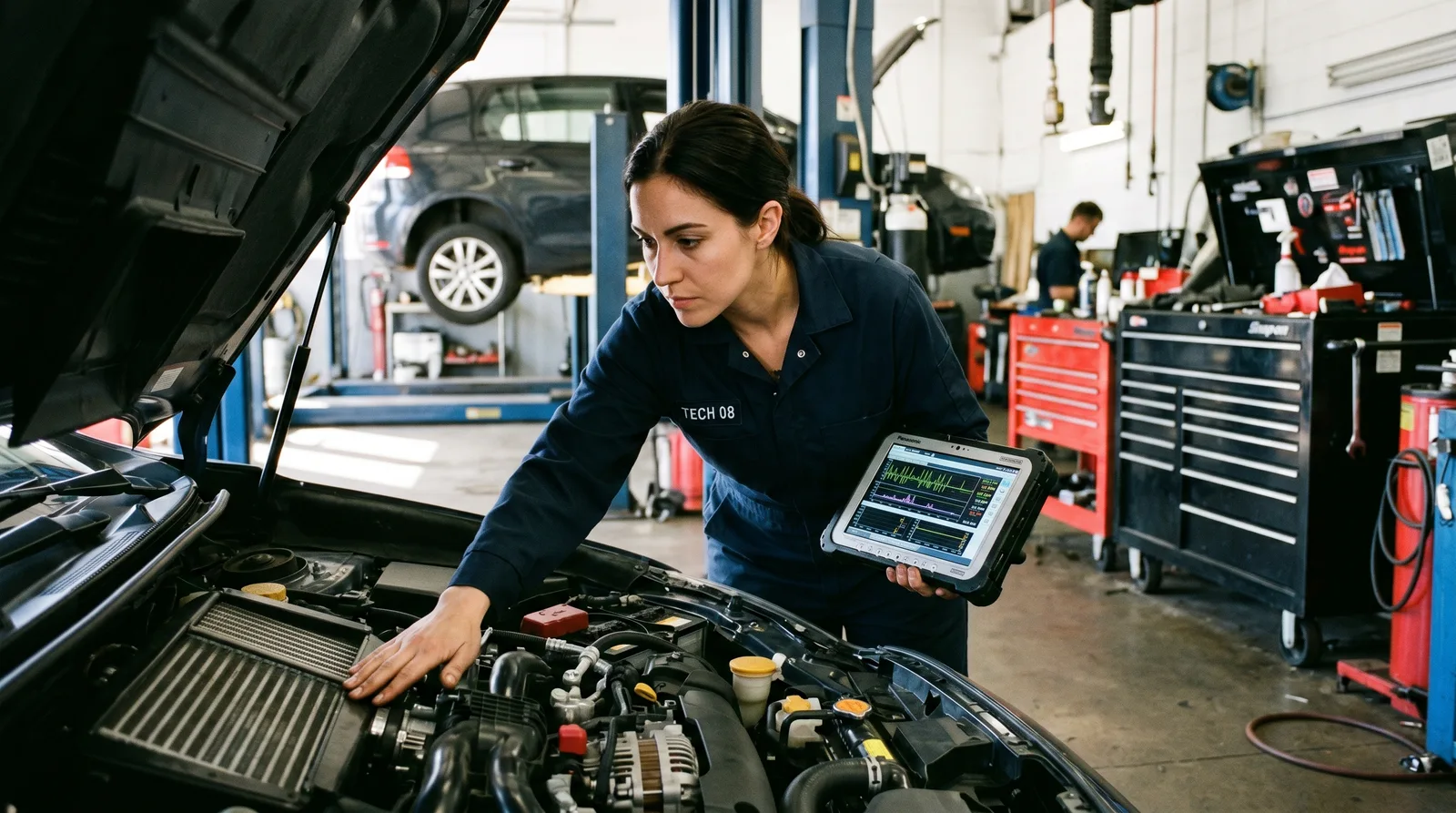
"The technicians who never get caught out aren't the ones with the most experience — they're the ones with the most disciplined diagnostic process, and that process is exactly what this course builds."— Enstay
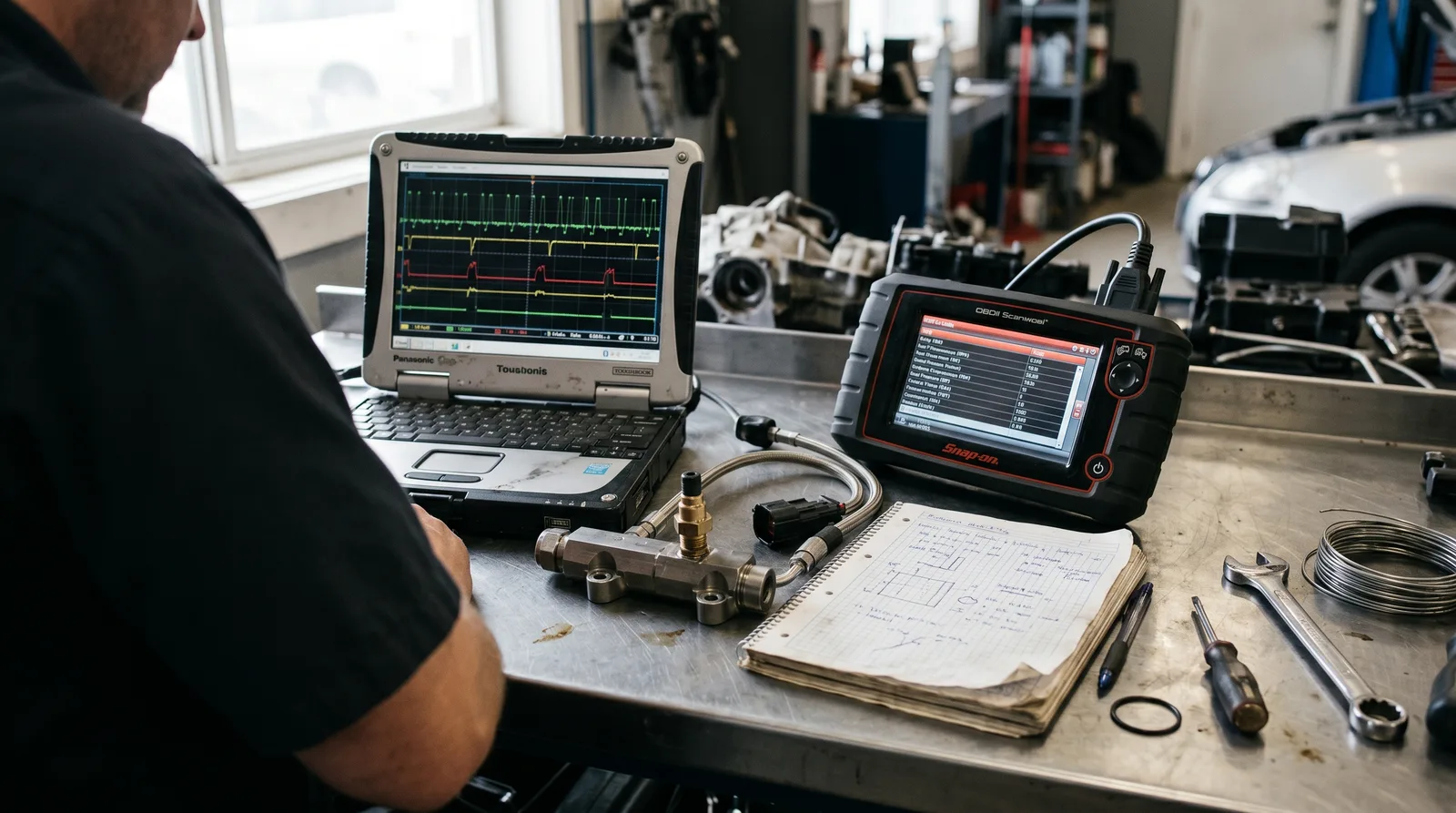
What you'll learn
What you'll be able to do
- Perform a full OBD-II/EOBD diagnostic workflow on Petrol, Diesel, Hybrid, and EV platforms using professional scan tools and live data interpretation.
- Pinpoint the root cause of engine misfires, NVH complaints, and sensor faults — including MAF, MAP, IAT, crankshaft, camshaft, and O2 sensors — using oscilloscope waveforms and freeze-frame data.
- Diagnose and resolve complex fuel system faults across petrol direct injection, common-rail diesel, and hybrid high-voltage architectures, including FRP sensor and diesel pressure regulator failures.
- Carry out turbocharger, EGR, and DPF pressure sensor diagnostics to restore emissions compliance and engine performance on modern forced-induction engines.
- Decode and troubleshoot vehicle network (CAN/LIN/FlexRay) communication faults, SRS airbag systems, Electronic Stability Program modules, and accelerator pedal position sensor issues.
- Earn a recognised US & UK accredited certification that validates professional competency in automotive diagnostics and supports career advancement or independent workshop credibility.
How it works
A school that adapts to you
This isn't a set of static videos. Every lesson is generated live and tuned to where you actually are.
We learn your level
A quick placement check tailors your starting point so you're never bored or lost.
Lessons adapt as you go
Each lesson is written for your pace and your goal, adjusting as your skills grow.
Your AI coach keeps you moving
Checkpoints, feedback, and gentle nudges turn progress into a real result.
The curriculum
What's inside your school
21 modules · 89 lessons

Mastering Onboard Diagnostics
This foundational module establishes every competency students need before touching a fault — from understanding OBD-II/EOBD legislation and architecture across Petrol, Diesel, Hybrid, and EV platforms, to professional scan tool operation, oscilloscope mastery, and a structured diagnostic workflow aligned with US (ASE) and UK (IMI/ATA) accreditation standards. Nothing in later modules is attempted without these prerequisite skills.
- 1.1Strategy Based DiagnosticsIncluded
- 1.2On-Board Diagnostics - Generation 1Included
- 1.3On-Board Diagnostics - Key ElementsIncluded
- 1.4On-Board Diagnostics - Key Elements 2Included
- 1.5Control Module Power & Ground Circuit ChecksIncluded
- 1.6Understanding Diagnostic Trouble CodesIncluded
- 1.7Understanding Drive CyclesIncluded
- 1.8Drive Cycle DiagnosisIncluded
Engine Misfire Diagnostics
Builds directly on Module 1 scan tool and oscilloscope skills to diagnose the full spectrum of misfire causes — ignition, fuel, mechanical, and hybrid-specific — across petrol, diesel (which uses glow plugs not ignition coils), and hybrid drivetrains. Students learn to use misfire counters, cylinder contribution tests, in-cylinder pressure waveforms, and compression data to pinpoint root cause rather than parts-swap.
- 2.1Engine Misfire MonitoringIncluded
- 2.2Undetermined Misfire DiagnosticsIncluded
- 2.3Automotive Thermal Imaging & DiagnosticsIncluded
- 2.4Knock Sensor - Voltage HighIncluded
NVH Principles & Diagnostics
Equips students with the theory and practical skills to diagnose Noise, Vibration, and Harshness complaints systematically across all drivetrain types. This module bridges mechanical diagnostic skills with electronic tools (NVH analysers, data loggers) and is sequenced after misfire diagnostics because many NVH complaints originate from engine combustion irregularities already studied.
- 3.1Understanding NVH - NoiseIncluded
- 3.2Understanding NVH - VibrationIncluded
- 3.3Understanding NVH - HarshnessIncluded
- 3.4Understanding NVH - DiagnosticsIncluded
Starter Relay Diagnostics
In this module, you'll develop a thorough understanding of starter relay operation and learn how to systematically diagnose faults that prevent a vehicle from cranking or starting. We begin by exploring the starter relay's role within the broader starting circuit — covering how it controls high-current flow to the starter motor and how it interacts with the ignition switch, battery, and engine control systems across Petrol, Diesel, EV, and Hybrid platforms. You'll learn to identify the common symptoms of a faulty starter relay, including no-crank conditions, intermittent starting faults, and unusual clicking noises, before moving into hands-on diagnostic procedures. Using both basic electrical tools and professional scan tools, you'll practise testing relay coil resistance, contact continuity, voltage drop, and control-side trigger signals — building a repeatable, evidence-based diagnostic workflow. By the end of this module, you'll be able to confidently distinguish a defective starter relay from other starting system faults, accurately interpret your test results, and carry out or recommend the correct repair — skills directly applicable to real-world workshop diagnostics.
- 4.1Starter Relay Circuit Malfunction DiagnosticsIncluded
- 4.2Starter Relay Circuit Voltage Low DiagnosticsIncluded
- 4.3Starter Relay Circuit Voltage High DiagnosticsIncluded
Oil Pressure Sensor Diagnostics
A precision-focused module that trains technicians to diagnose the full range of oil pressure sensor circuit faults — from hard electrical failures to subtle signal performance issues — using live scan data, oscilloscope waveforms, and systematic circuit testing. Every lesson is grounded in real fault conditions across petrol, diesel, and hybrid platforms, giving technicians the tools to distinguish a failed sensor from a wiring fault, and a circuit fault from an actual lubrication problem — before engine damage occurs.
- 5.1Oil Pressure Sensor Circuit – Voltage Low DiagnosisIncluded
- 5.2Oil Pressure Sensor Circuit – Voltage High DiagnosisIncluded
- 5.3Oil Pressure Sensor Signal PerformanceIncluded
Crankshaft Sensor Diagnostics
A deep-dive into one of the most safety-critical sensors on any engine — the crankshaft position sensor (CKP). This module works through all four major failure signatures — signal performance degradation, voltage low, voltage high, and intermittent dropout — using real oscilloscope captures, live scan data, and structured fault-finding routines. By the end, technicians will distinguish a wiring fault from a sensor fault from a trigger-wheel fault with confidence, every time.
- 6.1Crankshaft Position Sensor Signal PerformanceIncluded
- 6.2Crankshaft Position Sensor Signal Voltage LowIncluded
- 6.3Crankshaft Position Sensor Signal Voltage HighIncluded
- 6.4Crankshaft Position Sensor Intermittent SignalIncluded
Camshaft Sensor Diagnostics
A forensic deep-dive into Variable Valve Timing (VVT) circuit faults — covering both the oil-control solenoid valves that drive cam phasing and the Hall-effect sensors that report cam position back to the ECM. You'll work through negative and positive control actuator valve failures, then tackle the two most common camshaft position sensor voltage faults, using live scan data, waveforms, and pressure readings to pinpoint root cause every time.
- 7.1Cam Position Actuator Valve – Negative ControlIncluded
- 7.2Cam Position Actuator Valve – Positive ControlIncluded
- 7.3Camshaft Position Sensor Voltage LowIncluded
- 7.4Camshaft Position Sensor Voltage HighIncluded
MAF Sensor Diagnostics
A precision-focused deep dive into MAF sensor fault diagnosis across petrol and diesel platforms — covering signal performance degradation, short-to-ground wiring faults, and out-of-range high-voltage conditions. You'll work directly with live data, oscilloscope waveforms, and DTC freeze-frame evidence to isolate root causes fast and avoid misdiagnosis.
- 8.1Mass Air Flow Sensor Signal PerformanceIncluded
- 8.2Mass Air Flow Sensor Short to GroundIncluded
- 8.3Mass Air Flow Sensor Signal Voltage HighIncluded
MAP & BARO Sensor Diagnostics
A precision fault-finding module covering every failure mode across pull-up and pull-down type MAP sensors and barometric pressure sensors — from voltage rail collapses to signal drift and dead shorts. Using live scan data, oscilloscope waveforms, and pinpoint voltage drop testing, you'll learn to distinguish sensor hardware failure from wiring faults, PCM reference supply issues, and ground integrity problems, so you close the job with a verified root cause every time.
- 9.1MAP Sensor Pull-up Type Voltage LowIncluded
- 9.2MAP Sensor Pull-up Type Voltage HighIncluded
- 9.3MAP Sensor Pull-down Type Voltage LowIncluded
- 9.4MAP Sensor Pull-down Type Voltage HighIncluded
- 9.5MAP Sensor Signal PerformanceIncluded
- 9.6Barometric Sensor Signal FaultsIncluded
- 9.7Barometric Sensor – Shorts to Voltage & GroundIncluded
IAT Sensor Diagnostics
Picks up directly where IAT Sensor Diagnostics leaves off — drilling into the three most common IAT fault codes a technician will encounter on the workshop floor. Each lesson works through a specific DTC category using real scan data, live waveforms, and circuit-level reasoning to separate a genuine sensor failure from a wiring fault, connector issue, or ECM input problem. By the end, you'll diagnose any IAT circuit fault with confidence, first time.
- 10.1IAT Sensor Circuit Voltage LowIncluded
- 10.2IAT Sensor Circuit Voltage HighIncluded
- 10.3IAT Sensor Signal PerformanceIncluded
Fuel System Diagnostics
Gain a thorough understanding of how modern fuel systems operate and learn to diagnose faults with precision and confidence. This module covers the full fuel delivery pathway — from the fuel tank and pump assembly through to injectors and pressure regulation — across Petrol, Diesel, EV, and Hybrid platforms. You'll explore common failure points, interpret live fuel pressure and injector data using diagnostic tools, and develop a structured approach to identifying root causes rather than just symptoms. By the end of this module, you'll be equipped to tackle fuel-related faults efficiently, reducing diagnostic time and avoiding unnecessary parts replacement.
- 11.1Fuel Injector Circuit LowIncluded
- 11.2Fuel Injector Circuit HighIncluded
- 11.3Fuel Trim – System Too RichIncluded
- 11.4Fuel Trim – System Too LeanIncluded
- 11.5Evaporative Systems Open CircuitIncluded
- 11.6Evaporative Systems Short to GroundIncluded
- 11.7Evaporative Systems Short to VoltageIncluded
FRP Sensor Diagnostics
A precision deep-dive into diagnosing Fuel Rail Pressure (FRP) sensor voltage faults across pull-up and pull-down circuit architectures. Each lesson isolates a specific fault condition — high or low signal voltage — and maps the exact electrical behaviour, likely root causes, and step-by-step diagnostic workflow using live scan data, wiring diagrams, and a multimeter or oscilloscope. By the end of this module, you'll be able to distinguish a genuine sensor failure from a wiring fault, a short to voltage from a short to ground, and a pull-up circuit from a pull-down circuit — without guesswork.
- 12.1FRP Sensor Voltage High — Pull-Up TypeIncluded
- 12.2FRP Sensor Voltage High — Pull-Down TypeIncluded
- 12.3FRP Sensor Voltage Low — Pull-Up TypeIncluded
- 12.4FRP Sensor Voltage Low — Pull-Down TypeIncluded
Diesel Pressure Regulator Diagnostics
A focused deep-dive into diagnosing diesel pressure regulator faults across all three failure modes — performance deviation, voltage low, and voltage high — using live FRP data, oscilloscope waveforms, and common-rail system behaviour. You'll work through each fault type the same way you would on the workshop floor: scan data first, circuit second, component last.
- 13.1Diesel Pressure Regulator PerformanceIncluded
- 13.2Diesel Pressure Regulator Voltage LowIncluded
- 13.3Diesel Pressure Regulator Voltage HighIncluded
Turbocharger Diagnostics
A deep-dive into diagnosing boost control failures across both wastegate and variable geometry turbocharger (VGT) systems — covering underboost and overboost fault conditions with real scan data, live pressure waveforms, and actuator-level testing. By the end of this module, technicians will confidently isolate whether a boost fault originates from a mechanical, pneumatic, electronic, or ECU-commanded failure, regardless of turbo architecture.
- 14.1Turbocharger Wastegate Type – UnderboostIncluded
- 14.2Turbocharger Wastegate Type – OverboostIncluded
- 14.3Turbocharger VGT Type – UnderboostIncluded
- 14.4Turbocharger VGT Type – OverboostIncluded
Oxygen Sensor Diagnostics
A precision-focused module that takes technicians beyond basic O2 sensor replacement and into circuit-level fault isolation — covering narrow band sensor performance degradation, heater circuit failures, and wide band pump cell faults. Every lesson is built around real scan data patterns, oscilloscope waveforms, and live vehicle behaviour so you can pinpoint root cause before you touch a component.
- 15.1Narrow Band Oxygen Sensor Poor PerformanceIncluded
- 15.2Narrow Band Oxygen Sensor Heater CircuitIncluded
- 15.3Wide Band Oxygen Sensor Pump Circuit LowIncluded
EGR Diagnostics
A deep-dive into EGR system fault isolation beyond basic valve operation — covering real-flow verification, position sensor signal faults, and performance-based diagnostics using live data, oscilloscope waveforms, and commanded vs. actual comparisons. By the end of this module, technicians will be able to distinguish a mechanical flow restriction from an electrical signal fault, interpret low and high voltage DTCs with pinpoint accuracy, and confidently condemn or clear an EGR component based on hard evidence, not guesswork.
- 16.1EGR Flow DiagnosticsIncluded
- 16.2EGR Position Signal Voltage LowIncluded
- 16.3EGR Position Signal Voltage HighIncluded
- 16.4EGR Signal PerformanceIncluded
DPF Pressure Sensor Diagnostics
Master the full diagnostic workflow for Diesel Particulate Filter differential pressure sensor faults across all four circuit configurations — voltage high and voltage low on both pull-up and pull-down biased circuits. Using live scan data, wiring diagrams, and oscilloscope traces, you'll learn to distinguish a genuine sensor failure from a wiring fault, a reference voltage issue, or an ECU-side problem — and nail the root cause first time, every time.
- 17.1DPF Pressure Sensor Voltage High — Pull-Up TypeIncluded
- 17.2DPF Pressure Sensor Voltage High — Pull-Down TypeIncluded
- 17.3DPF Pressure Sensor Voltage Low — Pull-Up TypeIncluded
- 17.4DPF Pressure Sensor Voltage Low — Pull-Down TypeIncluded
Vehicle Network Diagnostics
Dive deep into the communication backbone of modern vehicles with this comprehensive module on vehicle network diagnostics. You'll explore how in-vehicle networks — including CAN Bus, LIN, FlexRay, and MOST — enable seamless communication between control modules, and learn how failures in these systems can trigger complex, wide-ranging faults that are easy to misdiagnose. Through hands-on techniques and real-world fault scenarios, you'll develop the skills to identify network-related issues using diagnostic scan tools, oscilloscopes, and wiring diagrams. By the end of this module, you'll be equipped to confidently locate open circuits, short circuits, and module communication faults across Petrol, Diesel, EV, and Hybrid platforms — saving time and eliminating guesswork on even the most challenging network-related diagnostics.
- 18.1CAN HS - Short Circuit DiagnosisIncluded
- 18.2CAN HS - Short to Ground or Voltage DiagnosisIncluded
- 18.3CAN HS - Open Circuit DiagnosisIncluded
- 18.4LIN BUS DiagnosticsIncluded
- 18.5MOST BUS DiagnosisIncluded
- 18.6Low Speed BUS DiagnosticsIncluded
Accelerator Pedal Position Diagnostics
A forensic, hands-on breakdown of APP sensor diagnosis covering system architecture, plausibility faults, and voltage-range failures. You'll work through real scan data, live waveforms, and fault-injection exercises to confidently pinpoint whether the fault lies in the sensor, wiring, PCM reference circuit, or throttle-by-wire calibration — across petrol, diesel, hybrid, and EV platforms.
- 19.1Accelerator Pedal Position Sensor DiagnosisIncluded
- 19.2Accelerator Pedal Position Signal Not PlausibleIncluded
- 19.3Accelerator Pedal Position Signal Voltage LowIncluded
- 19.4Accelerator Pedal Position Signal Voltage HighIncluded
Electronic Stability Program Diagnostics
A precision-focused module that takes you inside the ESP subsystem's two most critical orientation sensors — the steering angle sensor (SAS) and yaw rate sensor — and the network infrastructure that ties them to the ESP module. You'll work through voltage high faults, CAN communication failures, and bus-level diagnostics using real scan data, waveforms, and live vehicle behaviour, building the systematic fault-finding discipline needed to resolve these faults without guesswork or unnecessary parts replacement.
- 20.1Steering Angle Sensor — Voltage High DiagnosisIncluded
- 20.2Yaw Sensor — Communication FaultIncluded
- 20.3ESP Bus DiagnosticsIncluded
SRS Diagnostics
A precision deep-dive into the four most critical SRS wiring and squib faults technicians encounter in the field — open circuits, shorts to ground, shorts to voltage, and pretensioner failures. Each lesson is built around real scan data, live resistance measurements, and deployment circuit behaviour, giving you the diagnostic logic to isolate faults safely and accurately without guesswork or unnecessary parts replacement.
- 21.1SRS Airbag Open Circuit DiagnosisIncluded
- 21.2SRS Airbag Short to Ground DiagnosisIncluded
- 21.3SRS Airbag Short to Voltage DiagnosisIncluded
- 21.4SRS Pretensioner DiagnosisIncluded
Who it's for
Is this you?

Experienced Workshop Technician
You've got years on the ramp but know your diagnostics rely too much on instinct — this course gives you the structured, evidence-based process to back every diagnosis with hard data.

Independent Garage Owner
Running your own workshop means every misdiagnosis costs you money and reputation — AutoDiag Pro's accredited certification and professional portfolio build the credibility that wins and keeps customers.

Aspiring Master Technician
You want to move from competent to exceptional — mastering oscilloscope waveforms, CAN/LIN network faults, and EV/Hybrid diagnostics is exactly what separates a senior tech from the rest of the bay.

Diesel & Commercial Vehicle Tech
Common-rail fuel systems, FRP sensor failures, DPF pressure faults, and turbocharger diagnostics are core to your daily work — this course covers every one of them at professional depth.

EV & Hybrid Specialist in Training
Electric and hybrid drivetrains are the fastest-growing segment in your workshop — AutoDiag Pro gives you the diagnostic frameworks to work safely and confidently on high-voltage platforms.

Auto Trade Student or Apprentice
You're building your skills from the ground up and want qualifications that actually mean something — this US & UK accredited course delivers a professional certification and portfolio before your career has even peaked.
Questions
Frequently asked
Your teacher
A note from your teacher

Enstay
If you've been in a workshop for any length of time, you already know the frustration. A vehicle comes in with a misfire code, you replace the coil pack, the plug, maybe the injector — and two weeks later it's back. Or a customer describes an NVH complaint you can barely replicate, and you're standing there staring at the car hoping something falls off so you can see it. That's not a skills gap. That's a process gap. And it's exactly what AutoDiag Pro is built to close.
This course exists because the diagnostic fundamentals — real oscilloscope waveform analysis, structured OBD-II workflow, live data interpretation across all four drivetrain types — are not taught systematically anywhere near enough in this trade. Most technicians pick up fragments on the job, fill the gaps with forum posts, and develop habits that work until they suddenly don't. The technicians who never get caught out are the ones who can read a crankshaft waveform and know exactly what it's telling them. Who can open a scan tool on a common-rail diesel and pull FRP data that leads them straight to the regulator. Who can walk a CAN bus fault to the exact node breaking communication across the whole network. That level of diagnostic precision is learnable. That's what I built this course to teach.
Twenty-one modules. One hundred-plus supporting videos. Six months of practical, sequenced instruction that takes you from OBD-II and EOBD architecture through to SRS airbag systems, Electronic Stability Program diagnostics, and hybrid high-voltage fuel architectures. Every module is grounded in what you'd actually encounter on a workshop ramp — real scan data, real waveforms, real fault logic. There's no padding, no filler, and no hand-waving through the hard parts. We go through turbocharger diagnostics, EGR and DPF pressure sensor faults, MAF and MAP sensor waveform analysis, injector balance rates for misfire root cause — and we do it with the precision the job requires.
At the end of the programme, you'll sit a certification assessment and build a professional portfolio that earns you a recognised US & UK accredited qualification. That credential matters — whether it opens a door at a main dealer, justifies your labour rate to fleet customers, or simply confirms to yourself that you're operating at the level this profession demands.
If you're ready to stop guessing and start diagnosing, the door's open. Let's get to work.
— Enstay
Start your journey today
Join get instant access — learn at your own pace with an AI coach in your corner.
$39/mo
Recurring billing · cancel anytime
Enrolling a child? Sign up as a parent — you'll add your student right here after.
Secure checkout · Instant access
- 21 modules, 89 lessons
- AI-adaptive lessons tuned to your level
- Quizzes & checkpoints to lock in progress
- Your own AI learning coach
- Learn on any device, at your pace
- Full access for as long as you're subscribed